
When people hear “trademark registration,” most of them picture an application form. But the form is the easy part. The problem we run into most often when we design logos is a different one: a name someone spent weeks on gets turned down because of a similar mark. Or the mark gets registered, but the domain name and the social media handle already belong to someone else.
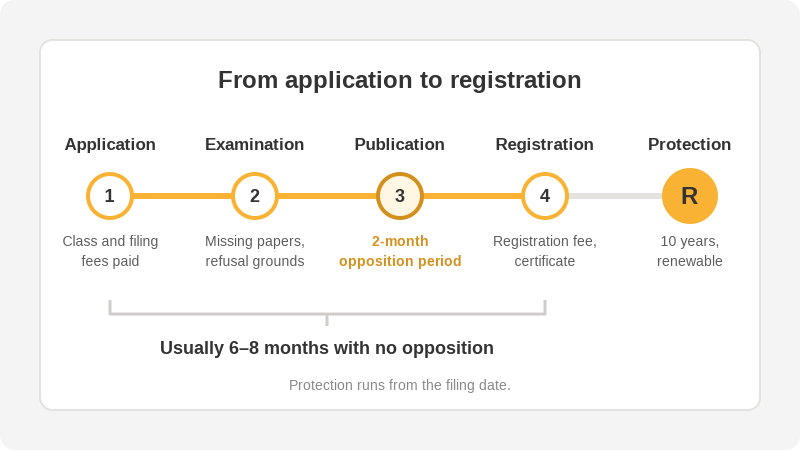
The short answer: In Türkiye, you register a trademark by applying to the Turkish Patent and Trademark Office (TÜRKPATENT). The application is examined and then published in the Official Trademark Bulletin for two months; if no one opposes it, the mark is registered and protected for 10 years from the filing date. An application that draws no opposition is usually finalized in 6–8 months. In this post we first cover the research to do before you apply, then the steps of the application itself.
Step one is research, not registration
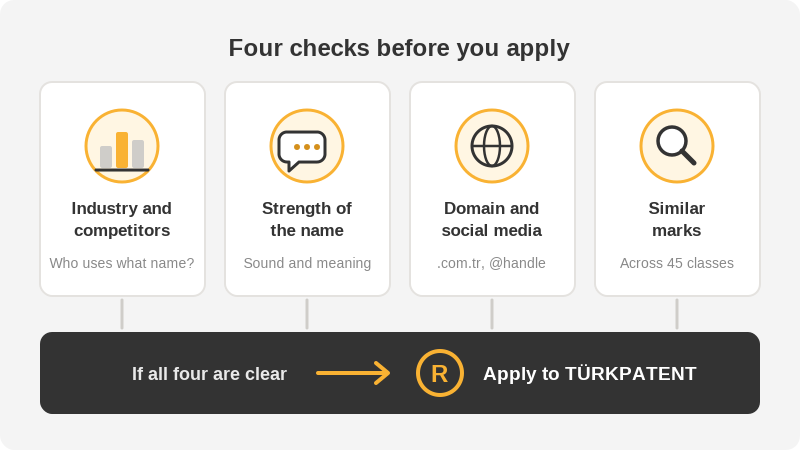
A good brand name isn’t just a name that can be registered. It should be easy to say, easy to remember, stand out in its industry and be yours to claim online. That’s why we check four things before applying.
1. Know your industry and competitors
Make a list of the businesses doing the same work in your city. In some industries the names all sound alike: half the pastry shops have “lezzet” (taste) in their name, and half the software companies use “soft,” “tech” or “bilişim” (IT). Words like these make a brand disappear in the crowd, and on their own they can’t be protected. Look at the colors and the tone of voice your competitors use, too; that’s exactly where you want to look different.
2. Test the strength of the name
A few simple tests are usually enough:
- The phone test: Say the name once over the phone. Can the other person write it down without asking you to spell it?
- Spelling: Turkish letters like ş, ğ and ı cause trouble in domain names and abroad. “Çağdaş” becomes “cagdas” online, so plan for that from the start.
- Meaning: If you’re thinking about exporting or tourism, does the name mean something funny or negative in another language?
- Distinctiveness: Names that simply describe the business, like “Quality Cleaning” or “Sakarya Furniture,” are hard to remember and hard to register. The law lists signs that merely describe the goods or services among the grounds for refusal.
- Length: Is it easy to read on a storefront sign, an app icon and a business card?
3. Check the domain name and social media accounts
Once the name is settled, the first thing to do is check whether the .com.tr and .com domains are available. Since 2022, .com.tr domains have been assigned first come, first served, with no documents required, so if the name you like is free today, it makes sense to register it right away. Being able to get the same username on Instagram, LinkedIn, YouTube and TikTok matters too. Showing up under a different name on every platform makes it harder for customers to find you.
4. Search for similar trademarks
You can search registered trademarks for free with the trademark search tool on TÜRKPATENT’s website. Here’s what people often miss: it isn’t enough that no one has registered the exact same name. If a mark that sounds or looks very close to yours was filed earlier for the same or similar goods and services, your application may be refused or opposed. If you’re opening a café called “Lavanta,” then “Lavantta” or “La Vanta” could also be a problem.
Choosing the right classes for your search matters, too. Trademarks are divided into 45 classes; a café falls under Class 43, while a brand selling packaged coffee falls under Class 30. The same name can belong to different companies in different classes.
Trademark registration, step by step
- Choose your classes. Pick the classes that cover what you do today and what you plan to do in the near future. Every extra class raises the fee; unnecessary classes drain the budget, and missing ones weaken your protection.
- Prepare the mark itself. For a word-only application, the name is enough; an application with a logo needs a clear image of the logo. You can’t make substantial changes to the mark after you file, so don’t apply until the logo is final.
- File the application. Applications are filed through TÜRKPATENT’s online system. You can apply yourself with your e-Devlet (Türkiye’s e-government portal) password or an e-signature, or have a registered trademark attorney file it for you. The application and class fees are paid at this stage.
- Examination. The office first checks for missing information or documents, then whether the mark can be registered. Partial or full refusals, for reasons like a similar mark or a descriptive name, come at this stage.
- Publication in the bulletin. An application that passes examination is published in the Official Trademark Bulletin. Anyone who believes their rights are affected can file an opposition within two months.
- Registration. If there’s no opposition, or if any oppositions are rejected, you pay the registration fee, the mark is entered in the register and a registration certificate is issued.
Why are applications most often refused?
- Similar mark: An identical mark, or one too similar to tell apart, that was already filed or registered for the same kind of goods and services.
- Descriptive name: Terms that merely describe the goods or services and that everyone in the industry uses.
- Misleading name: Signs that give a false impression about the nature of the product or where it was made.
Then there are applications that aren’t refused but don’t do their job. If the wrong classes are chosen, the mark gets registered but doesn’t protect the work you actually do. You usually find out when a competitor shows up with a similar name.
How long does trademark registration take, and what does it cost?
An application with no opposition is usually registered in 6–8 months. If there is an opposition, the process takes longer; reviewing it can take months. Your filing date sets your priority and the protection period starts from that date, but your trademark rights become final only with the registration decision.
The cost has three parts: the application and class fees, the registration fee and, if you work with an attorney, their service fee. Official fees are updated every year; you can find the current amounts in TÜRKPATENT’s fee schedule. The number of classes affects the total more than anything else.
Should you register the name or the logo?
A word-only application protects the name no matter what typeface it’s written in. An application with a logo protects how the logo looks; when the logo is redesigned, the new version often needs a separate application. If your budget covers only one application, we usually recommend protecting the name first, because logos change over time but the name stays. If the name isn’t distinctive enough on its own, an application with a logo may be easier to register; we look at this together during the preliminary search.
What to do after registration
- Keep an eye on the bulletins. Opposing new applications that resemble your mark is up to you; the office won’t do it for you.
- Use the mark. A mark that goes unused for five years after registration without a valid reason can be revoked.
- Don’t miss the renewal. Protection is renewed every 10 years. You renew within the six months before the term runs out.
How we can help
The brand name and logo are the first step in our corporate identity work. We go through your name options with you, looking at the industry, domain names and similar marks, and we do the preliminary search for free. The application is filed on your behalf by our partner, a registered trademark attorney, and we follow the process all the way to the registration certificate. We can also do a preliminary search for brands whose logo we didn’t design.
If you’re curious about the whole system, from the brand name to the business card, take a look at our post on corporate identity.
Sources: Industrial Property Law No. 6769, TÜRKPATENT. Information current as of November 2026; this post is not legal advice.