

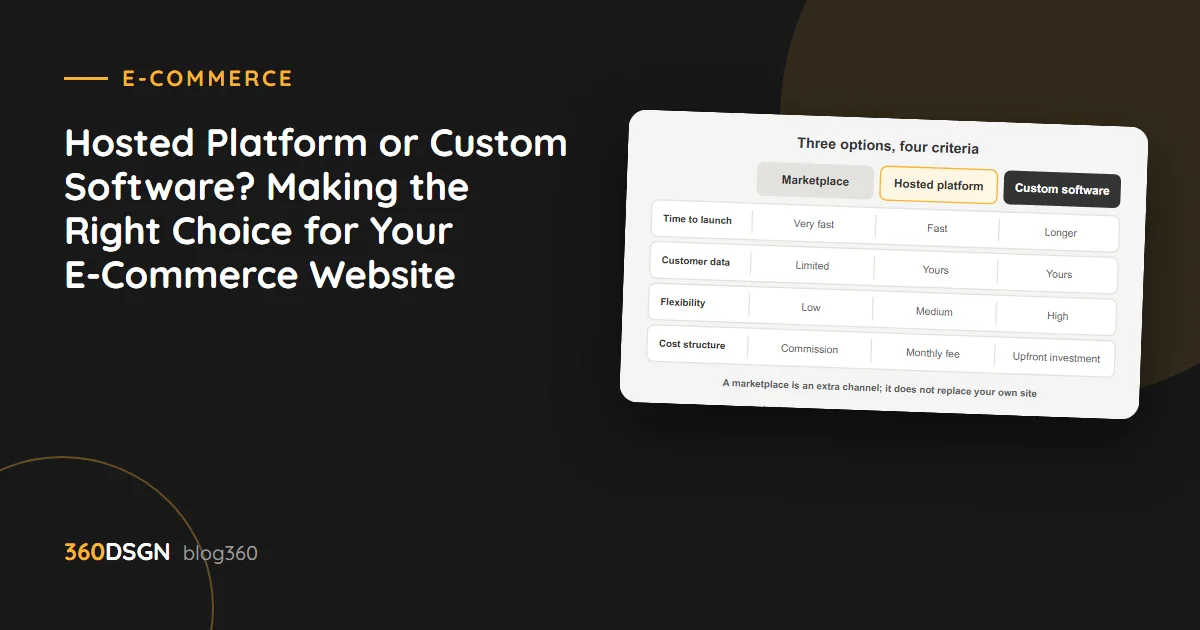
When you start out in e-commerce, the first decision is the platform: a ready-made package rented by the month, or a custom site written around your business? The short answer: if your sales flow is standard, a hosted platform is usually enough; if the rules of your business don’t fit the mold, you need custom software. A marketplace, meanwhile, is not an alternative to these two but a complement. In this post we explain how the three options differ and which criteria to use when deciding.
First, let’s separate the marketplace from your own site
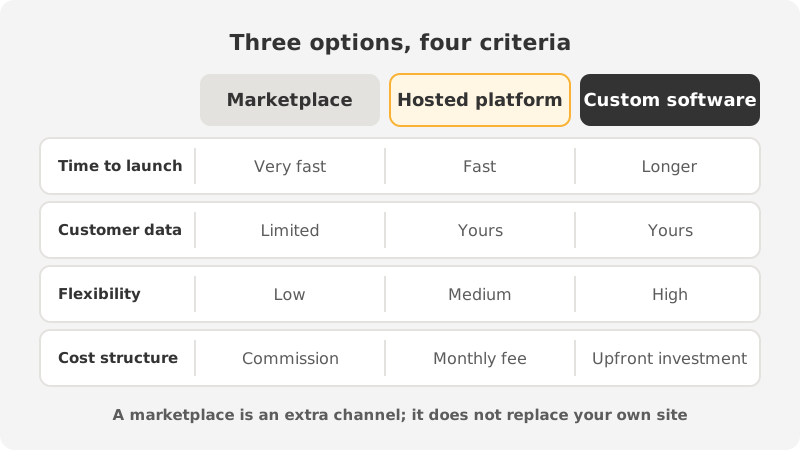
Opening a store on a marketplace is quick, and you reach a ready-made audience. In return, you pay a commission on every sale, the marketplace sets the rules, and your relationship with the customer goes only as far as the marketplace allows. You sit side by side with your competitors on the same page.
On your own site, you bring in the visitors yourself, and that takes effort and advertising. In exchange, the brand, the customer data and the rules belong to you. Repeat sales, email announcements and campaign design are in your hands. Many businesses run both together: the marketplace brings volume, while their own site builds the brand and a lasting customer base.
What is a hosted platform (a rented package)?
With a hosted platform you don’t have software written; you rent it for a monthly or yearly fee. Product management, cart, payment and shipping integrations come ready to use. You pick a theme, enter your products, and the site goes live quickly. Its strengths are:
- A fast start: Because the software already exists, the work is limited to entering products and adapting the design.
- Predictable cost: No large upfront software investment is needed.
- Maintenance isn’t on you: The platform provider handles updates, security and servers.
- Ready-made integrations: Most packages include virtual POS, shipping, e-invoicing and marketplace integrations.
It has limits, too. You can change only as much as the package allows. Fundamentally changing the checkout steps or the pricing rules is usually not possible. The site stays open only as long as you keep paying the rent. Make sure from the outset that you can export your product, customer and order data if you ever want to leave.
When do you need custom software?
With custom software, the site is written around the rules of your business. A ready-made package starts to feel tight in cases like these:
- Dealer or wholesale sales: prices, payment terms and discounts that vary by customer.
- Personalized products: made-to-measure production, products configured from options, print previews.
- Custom integrations: two-way data exchange with your accounting, inventory or production software.
- An unusual sales model: rentals, subscriptions, quote requests, sales by appointment.
The price of custom software is just as clear: longer development time, a higher upfront cost and an ongoing need for maintenance. If you hold the source code and the data, you are not tied to a single vendor, so spell out ownership in the contract. We explain how we work on projects like this on our software page.
Which criteria should guide the decision?
1. Is your sales flow standard?
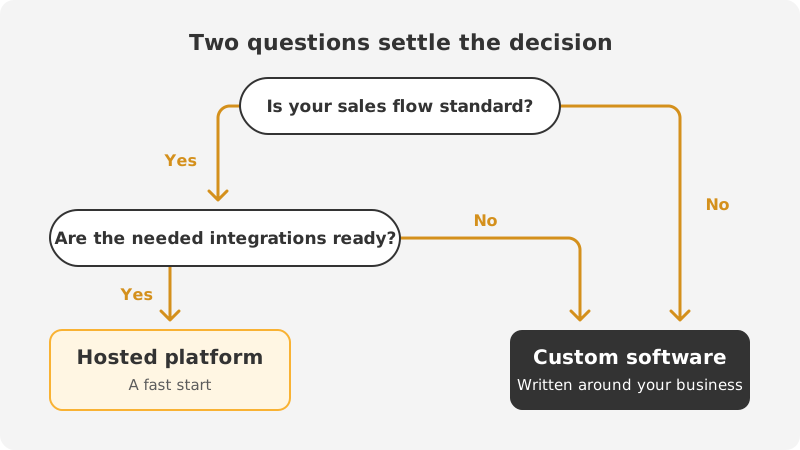
Pick the product, add it to the cart, pay, ship. If your business fits this flow, a hosted platform will do the job. If it doesn’t, look at a custom solution instead of forcing the package.
2. Which software will the site need to talk to?
Does the hosted package have an integration for the accounting and inventory software you use? If so, no problem. If not, ask whether that integration can be built later.
3. How soon do you need to launch?
If not missing the season matters, starting on a hosted platform and moving to custom software later is a sensible route. Just make sure your data is portable.
4. Where do you want to be in a few years?
Think not only about today’s needs but about the ones that will emerge as you grow. Rental fees, commissions and add-on module charges add up over the years, whereas the cost of custom software is concentrated at the start. Compare the two over the same period.
What stays the same whichever you choose
A platform does not bring in sales on its own. Well-shot product photos, clear product descriptions, fast-loading pages and a checkout that inspires trust are needed with every option. Plan the photography for your product images alongside the platform decision. The legal texts are common to all, too: a distance sales agreement, return conditions and a personal data notice must be on every e-commerce site. And budget from the start for the advertising and search work that will bring visitors to the site.
In summary
If you sell standard products and want to start quickly, a hosted platform is the right choice; if your pricing, product or integration rules don’t fit the mold, custom software is. Think of the marketplace as an additional sales channel, not your only one. Whichever route you take, make sure your data belongs to you and is portable.
At 360DSGN, we start by listening to how your business works and then assess together which route suits you. For details, take a look at our e-commerce website page or contact us.