

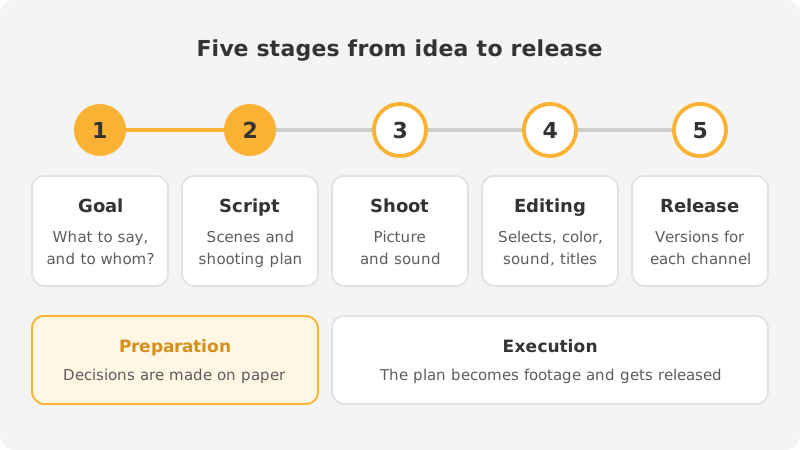
Whether a promotional video will turn out well is largely settled before the camera is switched on. The short answer: a promotional video is made in five stages: goal and target audience, script, shoot, editing and release. Each stage builds on the one before it. In this post we explain what happens at each stage and what you, as the business, need to prepare.
The process from idea to release
Video work is often thought of as “the shoot day.” But the shoot is only one of five stages. A large share of the effort goes into the preparation before it and the editing after it.
1. Goal and target audience
The first question is not “what kind of video do we want” but “what is this video for.” Will you be introducing yourself to someone hearing about the company for the first time? Showing how a product works? Will the video loop on a screen at a trade show? If the goal can be written in a single sentence, it is clear enough.
The second question is the viewer: an end user, a purchasing manager, a prospective dealer? The answer determines the video’s length, its language and what it shows or leaves out. Trying to fit everything into a single video is the mistake we see most often.
2. Script
The script is the video on paper. Which scene comes in which order, what appears on screen, what does the voice-over say, which text comes up on screen? The opening scene is especially important: that is where the viewer decides whether to keep watching. Once the script is approved, the shooting plan is drawn up:
- The locations to be filmed and the order of the scenes.
- The people who will appear on camera and their lines.
- The products, machines or processes to be shown.
- The shoot day and times, with a backup day if there is outdoor filming.
Changes are easy to make on paper and hard to make after the shoot. That is why we gather objections and additions at this stage.
3. Shoot
On the shoot day, the plan is carried out. The business has preparation of its own: the site is tidied, the production line is up and running, and the people who will appear on camera are briefed in advance. Sound matters as much as picture; in scenes with interviews and speech, audio is recorded separately. The length of the shoot depends on the number of scenes and locations; we share the plan in advance so that your work is not disrupted more than necessary on the day.
When the scale of a facility needs to be shown, aerial footage is added to the shoot. If the product is too large to film, or its inner workings need to be shown, animated scenes come into play.
4. Editing
In the edit, the best shots are selected, arranged in the order of the script, and everything unnecessary is removed. Editing is also a process of elimination: a scene that is well shot but doesn’t serve the goal stays out of the video. Color grading is done, music and voice-over are added, and the logo and titles are placed. On social media, videos are often watched with the sound off, so we prepare subtitles.
The first cut is sent to you. Collecting your corrections in one batch, rather than one at a time, speeds things up. The video is then finalized.
5. Release and versions for different channels
A single file does not fit everywhere. A website and YouTube call for horizontal video. In the Instagram feed, square or near-vertical video takes up more space. Reels and Stories run fully vertical. Length varies too: alongside the long version that lives on the site, short cuts are prepared for social media.
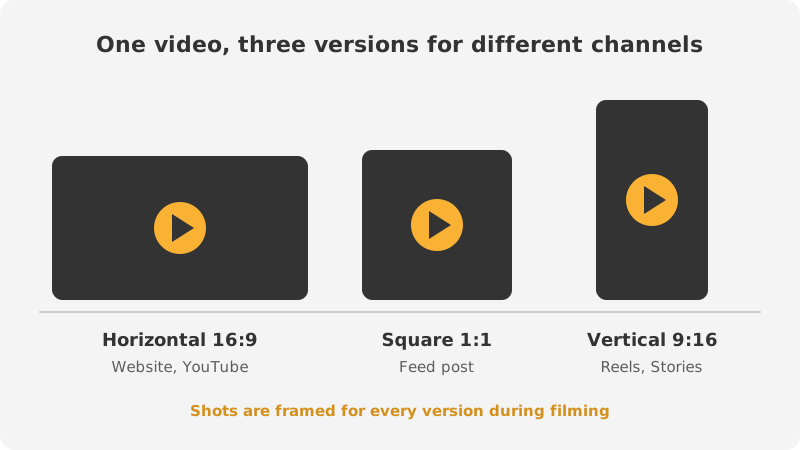
If the versions are planned from the start, shots are framed accordingly during filming. Converting a scene shot horizontally to vertical afterward usually leaves something important out of frame.
Release does not mean posting the video once and leaving it. The video is placed on the relevant page of the site, used piece by piece on social media, and shown in presentations and at trade shows. A suitably sized version is also prepared for the site so that it doesn’t slow the page down.
What should the business have ready?
A few things speed the process up:
- A single decision-maker. If approvals come separately from different people, the edit drags on.
- A short list of what absolutely must be in the video. Three or four items are enough.
- A few sample videos you like. They describe tone and pace more clearly than words can.
- Logo files and, if you have them, brand guidelines. Titles and colors are chosen in the edit to match.
In summary
A good promotional video starts with a goal, takes shape in the script, becomes footage in the shoot, comes together in the edit and goes out in the right versions. The time spent on the first two stages is won back in the three that follow.
At 360DSGN, we produce promotional videos end to end, from script to release. For details, take a look at our promotional video page or contact us.